Showing posts with label Chenal Ecarte. Show all posts

Tuesday, September 14, 2021

More Propwash: Waterway to Wallaceburg

 It has been a boring week so far, but tonight I will repeat one of my past blogs.  This one was entitled "The Bends".  (I am adding some stuff at the end of more historical interest.)


Today, I decided to write about a local waterway, namely the Chenal Ecarte or Snye River.  It is a unique winding and scenic watercourse that is a distributary of the St. Clair River flowing into Lake St. Clair.  The Sydenham River, running through Wallaceburg, flows into it at a bend west of town.
The name is French, but somewhat unclear in its meaning.  Loosely, it means 'apart', or 'separate', probably referring to the fact it branches off the St. Clair River.  It was sometimes called the "Lost Channel", as early explorers thought it seemed to go nowhere!  It was sometimes called Snye Carte as well.

The Snye borders Walpole Island and St. Anne's Island, and at one bend, branches into the Johnston Channel.  As a boater, I spent lots of time on Snye, with the Johnston being my favourite.  The latter waterway is a story for another time!
We have had several boats over the years, which were well-utilized to traverse the local waterways.


The Chenal Ecarte is a deepwater channel all the way to Lake St. Clair.  Wallaceburg was once one of the busiest ports in the province, hence the Snye was a good navigable waterway.  There is a good list of ships that plied these waters, both passenger and cargo.

Put-In-Bay


The land is so flat around this area, that the Snye can reverse its flow when certain conditions are met.  For example, when the Sydenham is running high in the spring, the Snye will reverse from the "forks" to the Johnston Channel and flow out the Johnston.
In rarer events, the entire river will reverse and flow back into the St. Clair River at Port Lambton!  (I have seen this a couple of times).

There are some sharp bends, four in particular, that had unique names.  These often presented challenges for larger ships.
The attached Google Image shows the Chenal Ecarte, with the bends labelled.  As well, there are other points of interest.  Wallaceburg would be in the top right.


Bend "A" is the Johnston Bend, appropriately named where the Johnston Channel begins.  It is a fairly wide bend.

Johnston Channel


Bend "B" is the well-known dark bend.  There is thick forest on St. Anne's Island creating a shade later in the afternoon.  It is a scenic spot, often photographed as shown in the following post cards.


It was always one of my favourite spots, as one could see or hear many birds.

Approaching Dark Bend early morning


Just before "Dark Bend", there is a spot on St. Anne's Island where the bones of Chief Tecumseh were allegedly buried after being removed from the Thamesville area.  The Thamesville site is near the east end of Baseline Road.  If one follows this road due west (and it is a perfectly straight line), it ends at the Snye west of Wallaceburg.  Here one can see St. Anne's Island, and this is where the bones of Tecumseh were allegedly buried!  I have the info on that story, but that is a story for another time!

A short distance downstream is Bend "C", "Devil's Elbow".  It is the sharpest bend in the river, hence its name.

Green-winged Teal in early summer


Heading downstream from there, one passes the area of the original Baldoon Settlement, established in 1804 by Lord Selkirk.  It was somewhat of a failure due to the swampy terrain not very suitable for farming, heavy clouds of mosquitoes in early summer, and long winters.

We soon come to Bend "D"....you guessed it, Baldoon Bend.  It was another fairly sharp bend.  One is getting close to Wallaceburg at this point!

Jolly Tiger II approaching Baldoon Bend


Not too much farther, one comes to a fork in the river, "E", where the muddy Sydenham flows into the Chenal Ecarte.  Here one can find an abrupt change in water colour.  You can actually see this in the image!  The emerald colour of the Snye, mixes with the mud-coloured Sydenham.  I always remembered this when I was young, going by in the boat.

From here, the Snye winds several kilometres southward until it reaches Lake St. Clair near Mitchell's Bay.

Label "1" on the Google Image is a point of interest, but it lies in the depths.  The Snye averages around 25-30 feet deep its entire length, but here there is a "hole" about 90' deep.  Why this is here, nobody knows!  If one pays attention at this spot when travelling by boat, you can see whirlpools at the surface over this deep spot.
Divers have descended on this spot and found the remains of oxen and a cart perhaps from the early 1800's, along with other artifacts.  Perhaps the river did not freeze as much here, and winter travellers were unaware of the dangers.

I do not have a boat now (!), but the Chenal Ecarte was always one of my favourite boating routes for birdwatching and its spendid scenery.


Wallaceburg was once known as Canada's Inland Deepwater Port where many ships traversed the waterways to the port.  One was the Glenlyon, which had a storied history.  You can read about it here:

http://iri.forest.mtu.edu/Shipwrecks/Pages/Glenlyon.htm


The Glenlyon came into Wallaceburg twice, in June 1915 and November 1921.  


Several photo were taken in 1921 as the Glenlyon attempted to turned around at  the "forks",


Glenlyon and tug Rooney

The Glenlyon lasted until 1924 when it foundered during a storm on Lake Superior.


Saturday, April 18, 2020

The Bends

Today, I decided to write about a local waterway, namely the Chenal Ecarte or Snye River.  It is a unique winding and scenic watercourse that is a distributary of the St. Clair River flowing into Lake St. Clair.  The Sydenham River, running through Wallaceburg, flows into it at a bend west of town.
The name is French, but somewhat unclear in its meaning.  Loosely, it means 'apart', or 'separate', probably referring to the fact it branches off the St. Clair River.  It was sometimes called the "Lost Channel", as early explorers thought it seemed to go nowhere!  It was sometimes called Snye Carte as well.

The Snye borders Walpole Island and St. Anne's Island, and at one bend, branches into the Johnston Channel.  As a boater, I spent lots of time on Snye, with the Johnston being my favourite.  The latter waterway is a story for another time!
We have had several boats over the years, which were well-utilized to traverse the local waterways.


The Chenal Ecarte is a deepwater channel all the way to Lake St. Clair.  Wallaceburg was once one of the busiest ports in the province, hence the Snye was a good navigable waterway.  There is a good list of ships that plied these waters, both passenger and cargo.

Put-In-Bay

The land is so flat around this area, that the Snye can reverse its flow when certain conditions are met.  For example, when the Sydenham is running high in the spring, the Snye will reverse from the "forks" to the Johnston Channel and flow out the Johnston.
In rarer events, the entire river will reverse and flow back into the St. Clair River at Port Lambton!  (I have seen this a couple of times).

There are some sharp bends, four in particular, that had unique names.  These often presented challenges for larger ships.
The attached Google Image shows the Chenal Ecarte, with the bends labelled.  As well, there are other points of interest.  Wallaceburg would be in the top right.


Bend "A" is the Johnston Bend, appropriately named where the Johnston Channel begins.  It is a fairly wide bend.

Johnston Channel


Bend "B" is the well-known dark bend.  There is thick forest on St. Anne's Island creating a shade later in the afternoon.  It is a scenic spot, often photographed as shown in the following post cards.


It was always one of my favourite spots, as one could see or hear many birds.

Approaching Dark Bend early morning


Just before "Dark Bend", there is a spot on St. Anne's Island where the bones of Chief Tecumseh were allegedly buried after being removed from the Thamesville area.  I have the info on that, but that is a story for another time!

A short distance downstream is Bend "C", "Devil's Elbow".  It is the sharpest bend in the river, hence its name.

Green-winged Teal in early summer


Heading downstream from there, one passes the area of the original Baldoon Settlement, established in 1804 by Lord Selkirk.  It was somewhat of a failure due to the swampy terrain not very suitable for farming, heavy clouds of mosquitoes in early summer, and long winters.

We soon come to Bend "D"....you guessed it, Baldoon Bend.  It was another fairly sharp bend.  One is getting close to Wallaceburg at this point!

Jolly Tiger II approaching Baldoon Bend


Not too much farther, one comes to a fork in the river, "E", where the muddy Sydenham flows into the Chenal Ecarte.  Here one can find an abrupt change in water colour.  You can actually see this in the image!  The emerald colour of the Snye, mixes with the mud-coloured Sydenham.  I always remembered this when I was young, going by in the boat.

From here, the Snye winds several kilometres southward until it reaches Lake St. Clair near Mitchell's Bay.

Label "1" on the Google Image is a point of interest, but it lies in the depths.  The Snye averages around 25-30 feet deep its entire length, but here there is a "hole" about 90' deep.  Why this is here, nobody knows!  If one pays attention at this spot when travelling by boat, you can see whirlpools at the surface over this deep spot.
Divers have descended on this spot and found the remains of oxen and a cart perhaps from the early 1800's, along with other artifacts.  Perhaps the river did not freeze as much here, and winter travellers were unaware of the dangers.

I do not have a boat now (!), but the Chenal Ecarte was always one of my favourite boating routes for birdwatching and its spendid scenery.


Sunday, February 5, 2017

Upriver Ducks (and gulls) 2017

Today was a decent day along the St. Clair River.  Viewing conditions were good and some areas had lots of activity.  The hotspot was at the head of Stag Island and the area near the Shell Refinery at Corunna.


A large number of Canada Geese were at Cathcart Park, but I did not see anything of note.  There could have been some Cackling Geese, but the sheer number of geese made things difficult.


I went up to Guthrie Park at Corunna where most of the ducks and gulls on the river were congregated.  There was a large number of Common Goldeneye as well as Bufflehead.


This curiosity was in close off Guthrie Park.


I went farther up as I waited for the Lambton Wildlife field trip to arrive downriver from Sarnia.  The first weekend in February is the annual Downriver Ducks trip for LWI.  It is the most popular outing for the group each year that attracts many people.  There were perhaps 35 people in the group ably led by "Uncle Paul".

Off the First Nation's territory, there was an insane number of gulls riding the ice floes.  Around 09:00, probably over 1000 gulls were present.  Most were Herring of course, and I think many of these headed back upriver even though there were still lots off Guthrie Park later. No doubt many more were along the Chemical Valley where we cannot see.

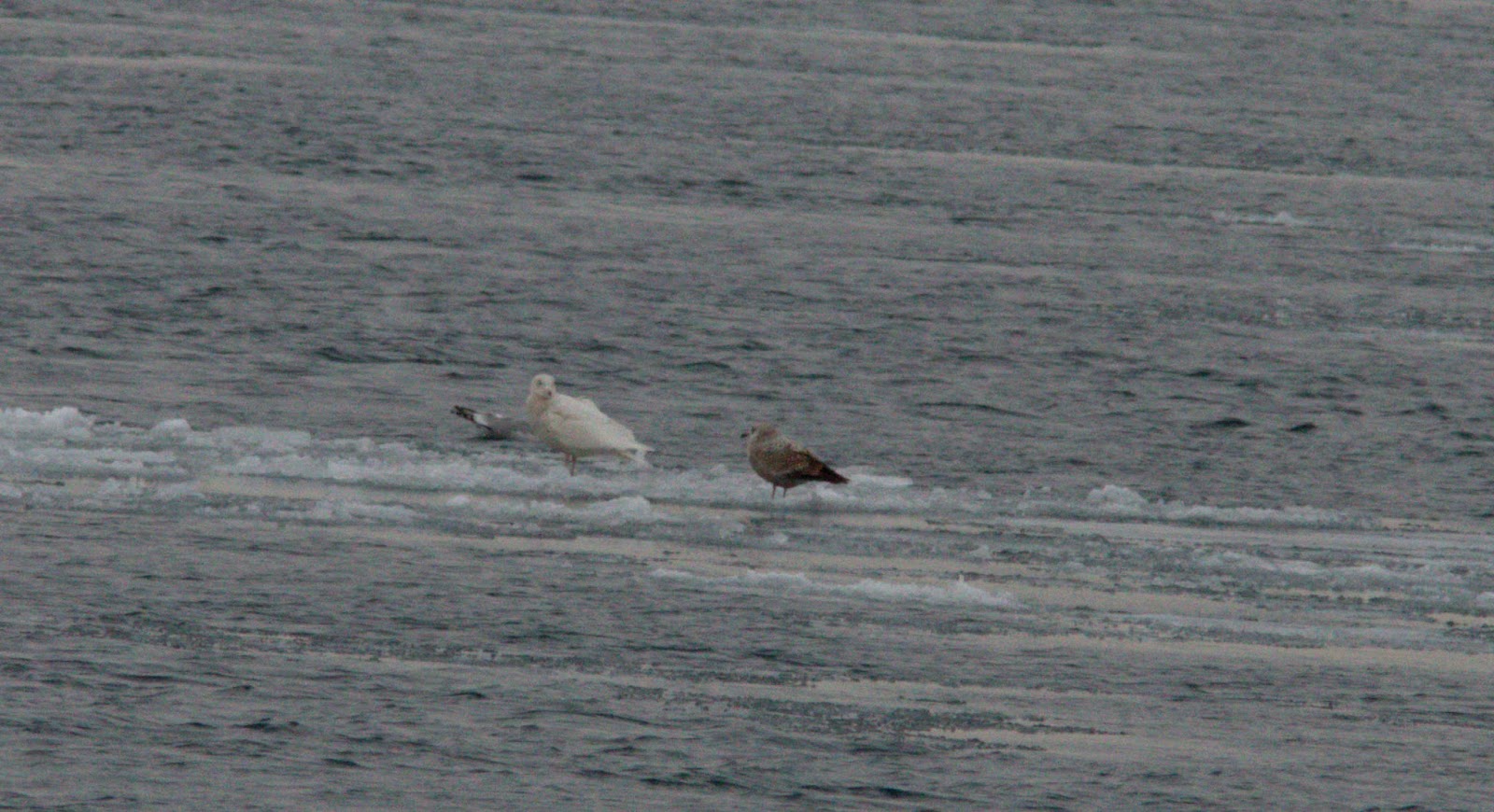
I went back to Guthrie Park just before the group arrived.  While there, I picked out 3 Iceland Gulls and a couple of Glaucous.


An adult Lesser Black-backed Gull was also seen in mid-river.


In the "cove" at the head of Stag Island there was a mass of ducks, mostly Redhead.  At one point they all got up.  It was a cloud of ducks!  There were probably over 5000.

Sameul Risley stirring things up!

Portion of the Cloud!


Long-tailed Ducks were in good numbers today, with several hundred.  A large number were also off Courtright.

Later, I cut inland and stopped by Moore WMA.  It was dead again!  Where are the birds??  This is usually a hotspot during winter.  While there, a mink scurried by the crossing.

Moore Mink


Later this afternoon, a Trumpeter Swan was noted on the Chenal Ecarte (Snye).


It must have just shown up as I go by that spot twice a day during the week!  In fact, there was quite a number of Mallards there today as well.  Also a drake Northern Pintail, Ring-necked Duck and a few Hooded Mergansers.
Two swans were sleeping and facing away from me.  Perhaps these were also Trumpeter, which Sean Jenniskens listed today.
These were at the usual spot on Walpole Island which always attracts lots of things.


Monday, November 2, 2015

Pelee Visit, Townsend's Solitaire, Swimming Deer

Sunday, I headed to Point Pelee as I had not been there in some time.  It was another slow day there! Seems I cannot get there on a decent day, but I only have weekends to work with.
I did a bit of a Tip watch with Alan Wormington and Marianne Reid.  Richard Carr also joined us, which turned out to be the rarest sighting of the day.  Dan Greenham also came along later.

There was not much moving this day, and I only saw 11 Common Loons among the other things. It was unlike the previous day, when Alan reported 962 Common Loons in just over two hours.  An insane number and hard to fathom!

There are not many places to walk in the park as many of the trails are closed for various reasons.  I walked Shuster anyway, but saw very little.

Next walk was De Laurier were there were a number of White-throated Sparrows.

Dogwood berry bonanza


At least 20 Chipping Sparrows were around the parking lot area.  It is interesting to sort through them in hopes of seeing a Lark Sparrow or something!


I did walk west beach trail south of west beach parking lot, but it was very windy.  Some butterflies were seen, but the strong wind did not help.  I had at least 4 Common Buckeye, a  couple of Eastern Comma and a Cabbage White.  Earlier we saw about 4 Monarch at the Tip.


I headed home via Dover Township area in hopes of seeing some blackbirds.  Friday evening I did get a Yellow-headed in a mixed flock SW of Wallaceburg.  It is not unsual to get a Yellow-headed this time of year.


I also stopped at St. Clair NWA where the dikes have been revamped.  Sight lines are better too!


While at Point Pelee, I got the message about a Townsend's Solitaire at Rondeau Park.  It was found by Garry Sadler near the south end of Lakeshore Road.  It is only second park record, with the first in April 2011 almost in the same area. At least I saw that one!
Here is a stellar photo by Garry, which he allowed me to post here.

Photo courtesy Garry T. Sadler
The solitaire was not refound today despite some effort.  Perhaps it will show up again like the last one, also along Lakeshore Road.

This morning was calm and clear since the weekend was over.  Why we cannot get these days on weekends is beyond me!
I took a walk at Stewart Wetland and noted the scenery.


Chenal Ecarte and Walpole Island


At one point I caught sight of a White-tailed Deer swimming in the Snye off Walpole Island!


Looks like nice weather this week and certainly a good  chance to see some late butterflies.